The Hidden Price of Openness: Why Open Standards Cost Developers More and What That Means for the Metaverse
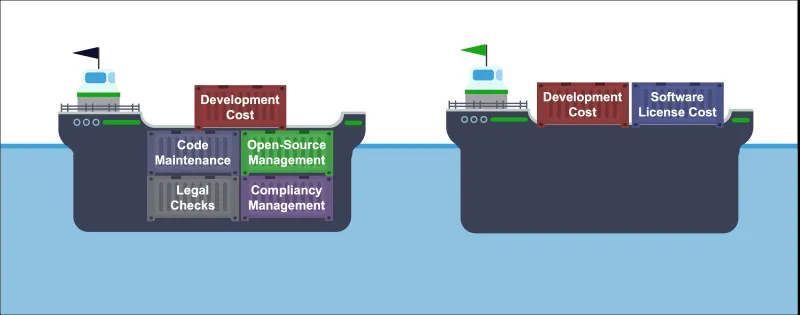
Photo: developer cost analysis economic comparison open source software whiteboard, via www.qt.io
The case for open metaverse standards is well-documented in technical and policy literature. Interoperable systems produce network effects that benefit all participants. Users gain mobility and choice. Developers gain access to broader markets. The aggregate economic output of an open ecosystem exceeds what any single walled garden can generate. The argument is coherent and, in the long run, probably correct.
It is also largely irrelevant to the developer deciding how to allocate a finite engineering budget in the next fiscal quarter. At that level of decision-making, a different and less frequently examined fact dominates: building for open standards costs more. Not marginally more—in many contexts, substantially more. Understanding why that cost gap exists, and whether it can be closed without regulatory intervention, is essential to any serious assessment of the metaverse's architectural future.
Where the Cost Difference Actually Lives
The cost premium associated with open standards development is not evenly distributed across the development lifecycle. It concentrates in specific areas that are worth examining individually.
Integration complexity. Proprietary platforms provide vertically integrated development environments. The SDK handles authentication, asset serialization, rendering optimization, and network synchronization through a unified interface that has been tested against a single known target environment. Open standards, by definition, require implementations that function across multiple environments with divergent underlying architectures. The developer building to an open standard must account for variability that the proprietary SDK developer never encounters. Testing matrices expand dramatically. Edge cases multiply. The engineering time required to achieve equivalent functional coverage is measurably higher.
Documentation quality gaps. Proprietary platform documentation is maintained by the platform vendor, who has a direct commercial interest in making it accurate and complete. Open standards documentation is maintained by committees, often on volunteer time, and tends to lag implementation reality. Developers working against open standards frequently spend significant time resolving ambiguities that their counterparts on proprietary platforms never encounter because the SDK simply handles the relevant behavior.
Tooling immaturity. Proprietary platforms invest heavily in developer tooling because reducing friction for third-party developers directly increases platform value. Open standards ecosystems produce tooling more slowly, through community contribution and grant-funded projects, and the tooling that exists is often less polished, less integrated, and less well-supported than its proprietary equivalents. The developer productivity gap that results translates directly into higher labor costs per unit of output.
Conformance verification overhead. A developer building for a proprietary platform can test functionality against that platform and ship. A developer building for an open standard must verify that their implementation actually functions across the range of conformant platforms the standard is meant to support. This cross-platform testing burden has no equivalent in proprietary development and represents a recurring cost that persists throughout the product lifecycle.
Quantifying the Gap
Precise cost comparisons between open and proprietary development are difficult to obtain because few organizations publish detailed internal cost data and because the relevant variables—team size, feature scope, target platform count—differ across projects. However, available evidence from adjacent domains provides useful reference points.
Studies of enterprise software integration consistently find that cross-platform compatibility requirements increase development costs by 30 to 60 percent compared to single-platform targets, with the higher end of that range applying when the target platforms have significant architectural divergence. Game development studios that have published retrospective analyses of cross-platform release efforts report similar premiums for platform-agnostic engine work relative to platform-optimized builds.
For metaverse-specific development, the relevant comparison is between building a virtual experience optimized for a single major platform's native toolchain versus building the same experience to function across multiple platforms using only standardized interfaces. Based on the integration complexity and tooling factors described above, a conservative estimate of the cost premium for the open approach falls in the range of 40 to 80 percent of initial development cost, with ongoing maintenance costs elevated by a similar proportion.
These are not trivial numbers for independent developers or small studios operating on constrained budgets. They represent the difference between a viable project and an unviable one.
Why the Market Has Not Solved This
Standard economic reasoning suggests that if open platforms generate superior long-term value, the market should eventually price that value into development decisions, narrowing the cost premium through investment in open tooling and documentation. This reasoning has not been borne out in practice, and examining why reveals something important about the structure of the metaverse market.
The value generated by open interoperability is largely captured by users and by the ecosystem as a whole, not by the individual developer who bears the cost of implementing open standards. A developer who invests the additional 50 percent of budget required to build for open standards enables user portability, competitive platform dynamics, and long-term ecosystem health—but does not necessarily capture more revenue than a competitor who built the same experience for a single proprietary platform at lower cost and reached the same users through that platform's distribution channel.
This is a classic collective action problem. The socially optimal outcome—widespread open standards adoption—requires individual actors to bear costs that their competitors avoid. Without a coordination mechanism, rational individual actors choose the lower-cost proprietary approach, and the aggregate outcome is a market that systematically underinvests in openness.
Network effects reinforce this dynamic. Proprietary platforms that accumulate large user bases become the rational development target regardless of their standards posture, because that is where the users are. The open ecosystem's theoretical long-term value cannot compete with the proprietary platform's immediate distribution reach in the budget conversations that determine architectural choices.
Potential Paths Toward Cost Parity
Several mechanisms could reduce the cost gap between open and proprietary development, though each faces real obstacles.
Shared tooling investment. If major platforms that nominally support open standards contributed engineering resources to shared open-source tooling—SDKs, testing frameworks, documentation infrastructure—the tooling maturity gap would narrow. This requires platforms to internalize costs that currently fall on the developer community, which conflicts with their competitive interest in maintaining proprietary toolchain advantages.
Conformance certification markets. A credible third-party conformance certification program could reduce cross-platform testing overhead for developers by providing verified profiles of platform behavior. Developers could test against the certification profile rather than against every individual platform. Building this infrastructure requires sustained funding that the current standards ecosystem has not reliably produced.
Regulatory intervention. The most direct mechanism for changing the cost calculus is regulatory: if platforms above a certain scale were required to support standardized interfaces as a condition of operating in the US market, the proprietary toolchain advantage would diminish because platform vendors would need to invest in standards-compliant implementations anyway. Developer tooling built against those implementations would benefit from that investment. This approach faces significant political and legal obstacles in the current US regulatory environment, but it is the mechanism most likely to produce rapid change if implemented.
What the Cost Gap Reveals
The economic premium attached to open standards development is not a technical problem awaiting a technical solution. It is a structural feature of a market organized around proprietary platform advantages, and it will persist until the incentive structures that produce it are altered—whether through coordinated industry investment, the emergence of open-ecosystem business models that successfully capture interoperability value, or regulatory requirements that change the competitive calculus.
For the standards community, acknowledging this reality honestly is more productive than asserting that market forces will eventually reward openness. They may. But the timeline for that outcome, absent deliberate intervention, is measured in decades rather than years—and the architectural choices made in the interim will shape the metaverse's structure long after the economic debate has been resolved.